

Planning, Land Use & Zoning Open House #1: January 25 - UPDATED
Feedback from the Open House - Updated February 17, 2026
What We Heard
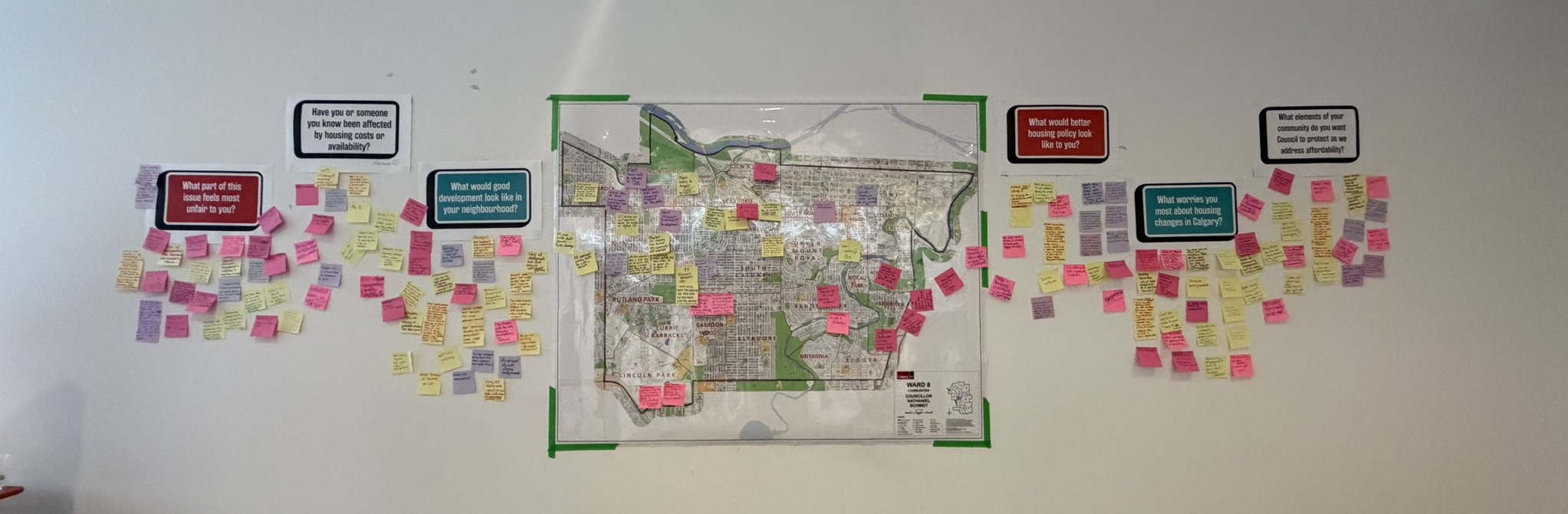
Thank you to everyone who shared their experiences, concerns, and ideas about housing and growth in Calgary. The feedback reflects a wide range of perspectives, but several clear themes came through consistently.
Residents understand Calgary needs to grow
Many residents agreed that Calgary needs more housing and that growth is necessary to address affordability, population change, and sprawl. People recognize that doing nothing is not an option, and several noted that without enough housing, prices will continue to rise and families will be pushed out.
At the same time, residents emphasized that how we grow matters just as much as how much we grow. Growth should be planned carefully and reflect the unique character and capacity of different neighbourhoods.
Emphasis on context-sensitive growth
Residents frequently highlighted the importance of tailoring growth and change to local conditions. Many shared that neighbourhoods differ in character, infrastructure capacity, and planning history, and that these differences should be considered when planning for growth.
Residents expressed a desire for growth that:
- Aligns with existing Area Redevelopment Plans and Local Area Plans
- Prioritizes locations such as transit corridors, main streets, and underutilized commercial areas
- Is distributed more evenly across the city to avoid concentrating change in a small number of inner-city communities
Some residents also noted frustration that certain neighbourhoods experience a disproportionate share of redevelopment, while others see relatively little change. Overall, there was a strong interest in approaches to growth that are balanced, equitable, and responsive to local context.
Infrastructure needs to keep up with development
One of the most common concerns was that infrastructure is not keeping pace with growth. People raised issues about:
- School overcrowding or schools at risk of closure
- Increased traffic and unsafe streets
- Transit service that does not meet the needs of higher density
- Utilities and technical infrastructure already at capacity
- Parking requirements that do not reflect Calgary’s current reality
Many residents said they are open to density, but only if roads, transit, schools, and services are planned and delivered alongside new housing.
Community engagement feels late and uneven
Many residents shared that engagement often feels like it happens after key decisions are already made. There is a perception that consultation can be more about “checking the box” than listening.
People also noted that:
- Renters, young people, and working families are underrepresented
- Long public hearings favour those with flexible schedules
- Developers are not always engaging meaningfully with neighbours
- Development often fails to follow the rules and there is a lack of enforcement or follow-up
Residents want earlier, more genuine engagement and opportunities to help shape outcomes, not just react to them.
Design quality strongly influences support for growth
Poor building design came up repeatedly as a reason people oppose development. Many residents said they are more accepting of density when buildings are:
- Well-designed and human-scale
- Compatible with surrounding homes
- Thoughtful about height, massing, and setbacks
There were frequent calls for higher design standards, more involvement from architects, and clearer expectations for quality. People feel that unattractive or poorly designed buildings damage trust and fuel resistance to change.
Parks, trees, and green space are deeply valued
Protection of parks, green space, and mature tree canopy was one of the strongest and most emotional themes. Residents repeatedly said:
- Parks and school sites should not be sold or developed
- We should be expanding existing tree canopy coverage
- Tree loss is permanent and conflicts with climate commitments
- Walkability and access to green space are essential to livable neighbourhoods
Many emphasized that once green space is lost, it cannot be replaced, and they expect Council to treat it as essential infrastructure.
Affordability is still out of reach for many
While new housing is being built, many residents questioned whether it is truly affordable. Concerns included:
- New townhomes and row housing priced beyond reach
- Units that are too small or impractical for families
- Development that appears to benefit investors more than residents
People also noted that social housing and market affordability are different challenges and need different solutions.
People want fairer distribution of change
Several communities feel they are absorbing more than their share of growth, while other areas with significant redevelopment potential remain underused. Residents called for:
- Greater focus on large sites and commercial areas
- More equitable sharing of density across the city
- Planning that considers cumulative impacts, not just individual projects
Moving forward
Overall, we heard a wide variety of feedback and ideas. Residents are asking for growth that is thoughtful, well-designed, fairly distributed, supported by infrastructure, and shaped with communities.
Thank you to everyone who took the time to share their views. We plan to have two more open houses in the coming weeks, so residents can continue to share their thoughts on this topic. More information on upcoming open houses can be found here.
We plan to use this feedback to propose and shape solutions to the challenges our city and communities face moving forward. If you have any questions, please reach the Ward 8 team at ward8@calgary.ca.
- Ward 8 Team
Original post - Published on January 17, 2026
Original post: January 17, 2026
Dear Ward 8 residents,
On December 15, 2025, City Council voted to proceed with a Public Hearing on the repeal of city-wide rezoning. On February 17, 2026, at 9:30am, there will be a Public Hearing on a new, proposed bylaw for electronic notification for bylaw amendments affecting more than 500 residents.
The results of this hearing will lead to further updates on the dates and notification process for the Public Hearing on repealing the rezoning bylaw.
Visit here and scroll down for more information on the February 17 Public Hearing: Public Hearing on Planning Matters
I know this is an issue important to many Ward 8 residents which is why our team is hosting a series of three townhalls on housing and rezoning.
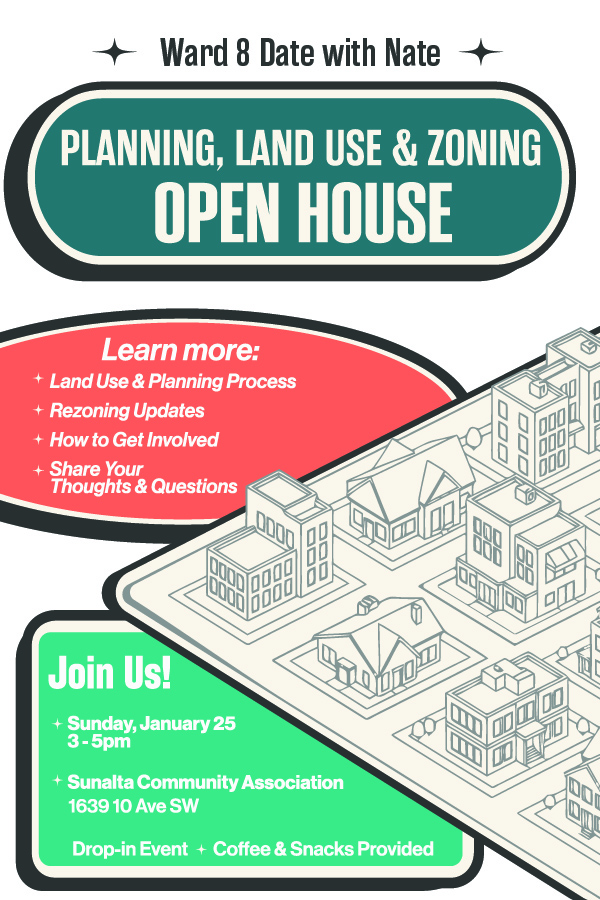
These townhalls are the first in an ongoing series of townhalls we plan to host over the next four years on all municipal issues titled “Ward 8 Date with Nate.”
All Ward 8 Dates with Nate are an opportunity to ask questions, share your thoughts, and chat with me and my team in a relaxed setting. Our goal is to provide feedback from each townhall through further newsletters and links on our website.
Our first Ward 8 Date with Nate on rezoning is Sunday, January 25 from 3 to 5 pm at the Sunalta Community Hub.
We are asking all those interested to RSVP on or before January 24 to save your spot.
Please use the button below for more details and to reserve your seat. The event is free and if you cannot attend, the next two townhall dates will be shared in the coming weeks.
Sincerely,
Nathaniel Schmidt
City of Calgary Ward 8 Councillor
Calgary.ca/Ward8
Categories: Events