

Downtown policy and regulation
Downtown policy and regulation
Proposed Amendments to the Beltline Area Redevelopment Plan: Parts 1 & 2, Chinatown Area Redevelopment Plan & Land Use Bylaw 1P2007 Centre City Districts
Jump to:
Downtown Strategy (City of Calgary) is advancing two projects to support a more predictable, contemporary and outcome-focused policy framework for the greater downtown communities.
Strategic amendments to Beltline and Chinatown Area Redevelopment Plans: The first project proposes amendments to the Beltline Area Redevelopment Plan: Parts 1 & 2, Chinatown Area Redevelopment Plan, and Land Use Bylaw 1P2007 Centre City Districts. These amendments will align policies with recent development application approvals and new construction typologies, support development along the downtown freight rail corridor, and facilitate heritage initiatives.
Policy amendments supporting the Culture and Entertainment District by enabling hotels: The second project proposes amendments to the Beltline Area Redevelopment Plan: Parts 1 & 2 and Land Use Bylaw 1P2007 Centre City Districts to support new hotel development in strategic areas within Beltline. The amendments aim to help grow Calgary’s visitor economy and leverage public investments made in the Culture + Entertainment District, a key tourism and culture destination within the Greater Downtown.
Background
Beltline Area Redevelopment Plans: Parts 1 and 2
The Beltline Area Redevelopment Plan (ARP) was adopted by City Council on May 15, 2006. Council later amended the ARP on April 29, 2019, to include a new Part 2 to facilitate development of a Culture and Entertainment District along with the Rivers District Master Plan (RDMP).
Council directed Administration to proceed with amendments to Part 1 of the Beltline ARP at that time. Over the last 20 years, Beltline has experienced significant growth, transforming into an increasingly vibrant and diverse community. Part 2 of the Beltline ARP was amended in 2019 to support the realization of a Master Plan vision to create a culture and entertainment district in Calgary. A number of new projects contribute to the need for further ARP amendments, including the new Greater Downtown Plan, the 17 Avenue South extension project and the future arrival of the Green Line.
Chinatown Area Redevelopment Plan
Tomorrow’s Chinatown was a Council-directed multi-year program comprised of three project deliverables: the Chinatown Cultural Plan, a culturally-informed Chinatown Area Redevelopment Plan (ARP) and the renaming of the former James Short Park and Parkade.
As a first-of-its-kind program for The City, Tomorrow’s Chinatown employed a “planning culturally” approach as identified in the Cultural Plan for Calgary. Planning culturally requires inclusive community consultation and decision making to identify cultural attributes, character and resources that can help a community achieve its civic goals. In taking this approach, it was the aim of the program to support Chinatown’s future as a vibrant, culturally-rich place to live, visit, work and do business.
The Chinatown Cultural Plan provides strategic direction for advancing and investing in Chinatown’s cultural future, including: cultural experiences and programs; spaces, facilities and amenities; and legacy businesses and tourism. It provides guidance for setting priorities, forming partnerships, assigning roles, and securing resources. The Chinatown Area Redevelopment Plan is a statutory document that sets out a comprehensive planning vision with policies to guide future redevelopment and investment in the plan area. It seeks to ensure new developments integrate cultural considerations that reinforce Chinatown’s unique identity.
Proposed Land Use Bylaw 1P2007 Amendments
The Centre City Districts in Part 11 of Land Use Bylaw 1P2007 apply to the entire Beltline community and fall within the Greater Downtown Plan boundary. The proposed amendments affect the four Centre City Districts and the Rules Governing Centre City Bonus Overlays, Division 7. The proposed land use amendments align the Land Use Bylaw with the proposed Beltline ARP density and related bonusing provisions.
Study areas
Strategic amendments to Beltline and Chinatown Area Redevelopment Plans
Proposed amendments
Density
Density
Amendment 1. 17 Avenue density increase
Increasing the maximum floor area along 17 Avenue, east of 4 Street S.W.: This amendment proposes increasing the floor area for parcels on 17 Avenue, east of 4 Street S.W. to enable additional density at key locations and better align the density areas with the recently approved West Elbow Local Area Plan, which allows for up to 26-storey development on the south side of 17 Avenue. The proposed changes will also improve alignment with recent site-specific floor area increases approved through development applications. This amendment applies to Beltline Area Redevelopment Plan: Part 1. See map note 1.
Construction
Construction
Amendment 2. 17 Avenue wood-frame construction
Increasing the floor area along a portion of 17 Avenue to enable 6-storey wood-frame construction: This amendment proposes increasing the floor area maximum for section of 17 Avenue S.W. between 7 Street S.W. and 12 Street S.W. to align new construction typologies. The Alberta Building Code has been amended to allow for 6-storey wood-frame developments, and the proposed floor area increase will enable this new construction typology. This amendment applies to Beltline Area Redevelopment Plan: Part 1. See map note 2.
Rail corridor
Rail corridor
Amendment 3. Freight rail corridor parking exemption
Exempting parking structures from floor area calculations adjacent to the downtown freight rail corridor: This amendment proposes a floor area exemption of up to a maximum of 2.0 floor area ratio for sites located along the downtown freight rail corridor. Due to their proximity to the downtown freight rail corridor, there are additional regulatory considerations for new development on adjacent sites, including sound attenuation rules. These regulations necessitate the need for parking structures for new development to be located above grade, instead of below grade. All above grade components of a development are calculated in a density calculation, which results in development adjacent to the rail corridor not being able to realize their full development potential. This amendment applies to Beltline Area Redevelopment Plan: Part 1 and Part 2. See map note 3.
3a. Beltline Area Redevelopment Plan: Part 1 - Map 3: Land Use Concept (proposed amendment):
3b. Beltline Area Redevelopment Plan: Part 2 – Map 4: Land Use Concept (Proposed Amendment)
Heritage
Heritage
Amendment 4. Heritage density transfer changes
Amendments to support heritage initiatives: This amendment proposes textual changes to improve the implementation of heritage density bonusing provisions by allowing density to be transferred to another location on a development site. Currently, density must be transferred from one site to another. This amendment applies to Beltline Area Redevelopment Plan: Part 1 and Part 2 and Chinatown Area Redevelopment Plan. See map note 4.
City District
City District
Amendment 5. Centre City District updates
Amendments to fix various textual errors: This amendment proposes correction of multiple textual errors where the wrong table is being referenced in the document. This amendment applies to Beltline Area Redevelopment Plan: Part 1. See map note 5.
Next steps
The City is informing community groups and industry members and collecting feedback about the proposed amendments. A summary of the targeted outreach will be included in the reports to Committee and Council later this year.
The project team will review the internal and external feedback from community groups and industry members and will work towards preparing a final version of these draft amendments to be presented to Calgary Planning Commission in July 2026 for recommendation to Council for a Public Hearing in September 2026.
Please submit your feedback to downtownstrategy@calgary.ca.
Timeline
Policy amendments supporting the Culture and Entertainment District by enabling hotels
Why hotels matter
Calgary’s visitor economy is growing! In 2025, Calgary welcomed more than 10.5 million visitors, generating $3.3 billion in visitor spending and supporting around 84,000 jobs. As we welcome more visitors, it is important to support the places they experience and stay, especially in downtown Calgary, which is a key destination.
Hotels are an important part of a thriving visitor economy. They provide accommodation and meeting spaces for tourists, business travelers, and event attendees. Hotels also contribute to Calgary’s economy by driving visitor spending, supporting local businesses, attracting investments, and strengthening the non-residential tax base.
On a neighbourhood scale, hotels bring more people to local businesses and attractions, help activate underutilized sites, and support a diverse mix of land uses, services and amenities. These benefits help create vibrant neighbourhoods for visitors, local residents and Calgarians to enjoy.
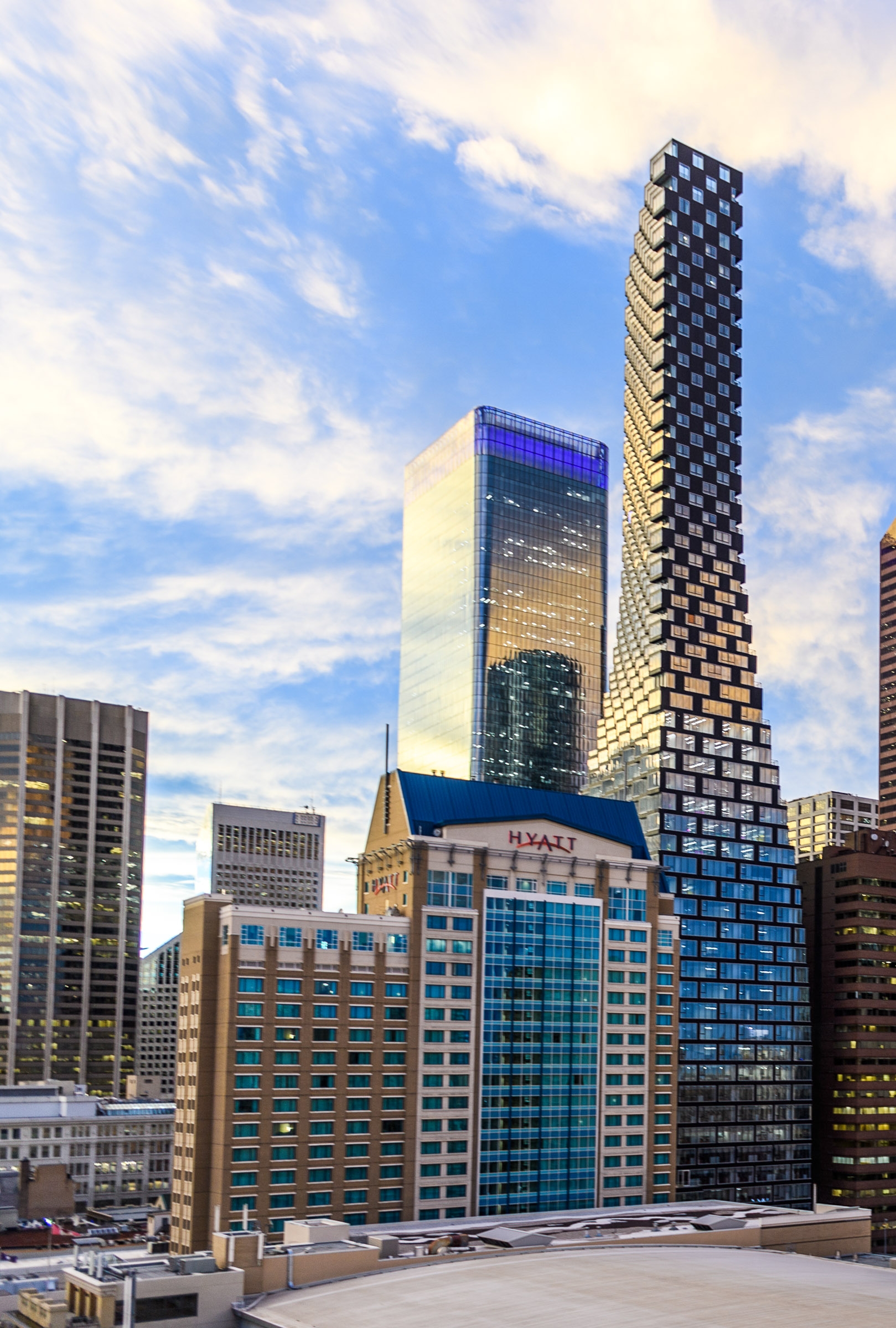
The need for hotels in The Culture + Entertainment District
In recent years, significant investments have been made in The Culture + Entertainment District (C+E) to enhance vibrancy and connectivity. These investments include the BMO Centre expansion, Scotia Place, and the 17 Avenue SE Extension & Victoria Park/Stampede Station Rebuild. Together, these investments are increasing Calgary’s ability to host more and larger conventions and events, while attracting more visitors to the city. Calgary is already seeing growth in demand for large meetings and conventions. In 2025, our downtown hosted 159 conventions and events, generating $241 million in economic impact.
With these infrastructure investments in place, Calgary is well-positioned to become a top-tier convention and event city. However, hotel supply is now a key constraint to future growth. When choosing a destination, convenient access to hotels near the convention centre is an important factor for convention organizers and event planners. Tourism Calgary has identified a need for 3,000 additional hotel rooms near the BMO Centre for Calgary to compete with other major convention destinations.
Therefore, without sufficient hotel rooms, Calgary is at risk of being less competitive in attracting major conventions and more visitors when competing with other North American cities. Increasing hotel supply near The C+E will help support continued growth in Calgary’s visitor economy and maximize the economic return of recent infrastructure investments.
Hotel projects are often more complex than other types of development. Hotel brands and operators have specific requirements related to the level of service, building design, hotel amenity offerings, operations, and back-of-house functions. These requirements can influence building design, building density needed and overall project feasibility.
Proposed amendments to support The C+E by enabling hotels
To support The Culture + Entertainment District and attract new hotel developments, Downtown Strategy (City of Calgary) is proposing amendments to the Beltline Area Redevelopment Plan (ARP): Parts 1 & 2 and Land Use Bylaw 1P2007 Centre City Districts.
The proposed amendments are intended to:
- Recognize hotels as an important use in Beltline and a key component of The Culture + Entertainment District, and;
- Improve regulatory flexibility to streamline the approval process for hotel development applications.
The proposed amendments include:
Density exclusion
Density exclusion
Amendment 1. Temporary hotel floor density exclusion
This amendment proposes temporarily excluding a portion of hotel uses from floor area (density) calculations during the Development Permit process within a targeted Hotel Density Exclusion Policy Area. The policy area includes:
- Beltline Area Redevelopment Plan Part 1: Along the CP Railway to 12 Avenue, between 8 Street S.W. and 1 Street S.E. (See map 5); and
- Beltline Area Redevelopment Plan Part 2: Between 1 Street and Macleod Trail S.E., and between the CP Railway and 12 Avenue, west of 5 Street S.E., and including a portion of the Stampede Park (See map 6).
This proposed density exclusion is intended to be temporary. The project team is currently exploring and is seeking feedback on the scope of eligible hotel uses and the extent of density exclusion, including an option with a cap on how much hotel density can be excluded in an application. This change is intended to catalyze new hotel developments near The C+E, where higher-density, larger-scale mixed-use buildings are already envisioned under the Beltline Area Redevelopment Plan.
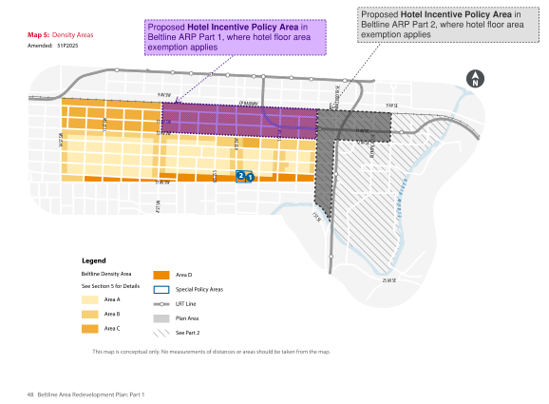
Map 5. Beltline Area Redevelopment Plan: Part 1 – Map 5: Density Areas (proposed hotel density exclusion)
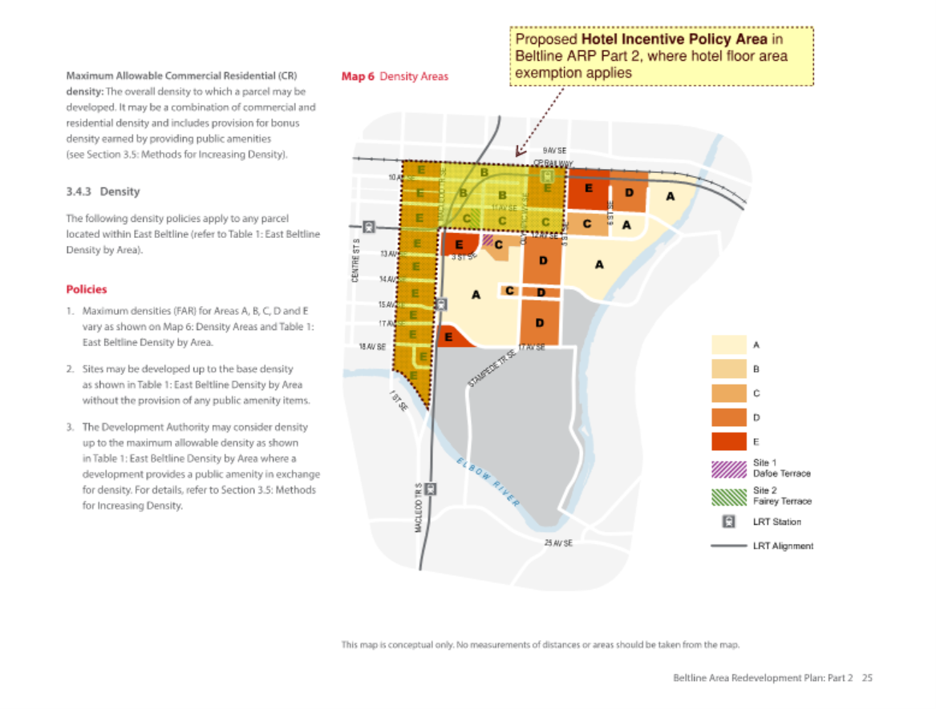
Map 6. Beltline Area Redevelopment Plan: Part 2 – Map 6: Density Areas (proposed hotel density exclusion)
Building design relaxations
Building design relaxations
Amendment 2. Allowing the Development Authority to consider relaxations to building massing and separation rules, on an application-by-application basis
This amendment will allow the Development Authority to consider relaxations to certain building design rules in the Beltline Area Redevelopment Plan where appropriate, on a case-by-case basis. The project team is currently exploring the scope of eligible building design rules.
This amendment will provide greater regulatory flexibility to address hotel brand requirements while continuing to support high-quality design outcomes.
What this means for hotel development applications
The proposed changes can reduce the approval timelines, project risks and soft costs associated with hotel projects during the Development Permit approval process, making projects more feasible.
Hotel density exclusion
Because a portion of hotel floor area will not count towards floor area (density) calculations, hotel developments within the Hotel Density Exclusion Policy Area (maps 5 and 6) may achieve additional density. The amount of density realized will depend on the specifics of each development application and the amount of hotel floor area proposed. In some instances, hotel developments may exceed the current maximum density identified in the Beltline Area Redevelopment Plan.
To reduce major impacts associated with additional density, the proposed temporary hotel density exclusion targets areas identified in the Beltline Area Redevelopment Plan Parts 1 and 2 where:
- Higher-density and larger-scale buildings are envisioned (i.e., areas with higher density maximums and where larger floor plates are allowed); and
- Hotel is supported as a use in mixed-use areas.
The density exclusion only applies to uses important for hotel operation and does not exempt other non-hotel uses from floor area calculations, even if they are proposed in the same development. This means that non-hotel uses will continue to be subject to existing density policies and regulations.
By removing a portion of hotel floor area from density calculations, any excluded portion of hotel floor area would also be removed from density bonusing calculations. The project team is evaluating a cap on how much hotel density can be excluded in an application. A capped approach would mean larger-scale hotels (i.e., those seeking bonus density beyond the hotel density exclusion cap) would still be required to earn bonus density through contributions to community amenities.
Allowing the Development Authority to consider relaxations to building massing and separation rules
The proposed amendment will provide the Development Authority with the ability to consider relaxations to certain building design rules, where appropriate, to better accommodate hotel brands’ and operators’ requirements.
All hotel development applications will continue to be evaluated through the standard Development Permit process.
Next steps
The City is informing community groups and industry members and collecting feedback about the proposed amendments. A summary of the targeted outreach will be included in the reports to Committee and Council later this year.
The project team will review the internal and external feedback from community groups and industry members and will work towards preparing a final version of these draft amendments to be presented to Infrastructure and Planning Committee on November 4, 2026 for recommendation to Council for a Public Hearing in December 2026.
Please submit your feedback to downtownstrategy@calgary.ca.

Timeline
Frequenty asked questions
Terminology
- Floor area ratio: Floor Area Ratio (FAR) shows how much building space there is compared to the land size. You calculate FAR by dividing the building's total floor area by the lot size.
- Density Bonusing: Density bonusing is a planning mechanism that allows developers to pursue extra density above base density limits in exchange for public amenity. The City sets a base density (FAR) that can be built without needing to give bonus items for extra density. If a developer wants to build more than the base density (FAR), they must give bonus earning items to get extra density (FAR). Developers can choose from a list of bonus earning items, which is generally outlined in a community’s policy plan. Bonus earning items can be:
- On-site public amenities: Indoor publicly accessible hotel space. Publicly Accessible Private Open Space (PAPOS) like parks, plazas, or recreational areas, public art, Indoor community or cultural spaces.
- Community Investment Funds: Beltline Community Investment Fund (BCIF)
- Heritage preservation: Heritage Density Transfer, Heritage Conservation.
- Maximum density: Maximum density is the maximum floor area ratio a development can achieve currently without a land use amendment. The density maximums of each parcel within Beltline are outlined in the Beltline Area Redevelopment Plan (ARP) Part 1 and Part 2 (Refer to Chapter 5 of the Beltline ARP Part 1 and Section 3.4 of the Beltline ARP Part 2).
- The Culture + Entertainment District: The Culture + Entertainment District (C+E) covers 286 acres of land in Calgary’s downtown eastside of east Victoria Park. It is envisioned as a vibrant, high-density, mixed-use community with a focus on entertainment. For details, please visit Calgary's New City Neighbourhood | Culture + Entertainment District
Why are these amendments being proposed?
The proposed amendments are intended to make it easier to develop hotels near the BMO Centre and the Culture + Entertainment District. Tourism Calgary has identified a need for 3,000 additional hotel rooms near the BMO Centre to compete at the level of other major convention cities. By reducing regulatory barriers, the proposed changes will help support additional hotel development near The Culture + Entertainment District and maximize the economic benefits of Calgary’s recent investments in major event and convention infrastructure.
How does density exclusion work?
Under the proposed amendments, eligible floor area used for hotel operations will not be included in the floor area ratio (FAR) / density calculations during the Development Permit application process within the Hotel Density Exclusion Policy Area.
Density exclusion is an existing tool in the Beltline Area Redevelopment Plan: Part 1. Currently, floor area associated with three-bedroom residential units is partially excluded from floor area calculations to encourage a greater variety of housing options within the neighbourhood. The proposed hotel density exclusion will apply a similar approach to support hotel developments in strategic locations.
What portions of a hotel will be excluded from floor area calculations? Will ancillary uses also be exempt?
The project team is currently evaluating which hotel components can be eligible for the density exclusion. As hotels are considered critical supporting infrastructure for the Culture + Entertainment District, the focus is on hotel spaces that are important for hotel operations.
Potential eligible hotel components being explored include:
- Guest rooms;
- Hotel circulation areas (e.g., hallways and lobbies);
- Hotel amenities (e.g., fitness and wellness facilities, restaurants and retail);
- Conference and meeting facilities; and
- Back-of-house spaces.
The proposed density exclusion is intended to support hotel operations and will not apply to non-hotel uses within a mixed-use development. The project team is currently seeking feedback to help refine the scope of eligible hotel components.
Can hotel developments propose density above the maximum density in the Beltline Area Redevelopment Plan? How will the maximum density be applied?
The density proposed for a hotel development will be evaluated through the individual Development Permit application process. Under the proposed amendments, eligible hotel floor area will be excluded from floor area calculations, which may allow some hotel developments to achieve additional density than the current maximum density identified in the Beltline Area Redevelopment Plan without requiring a land use amendment application.
As a result, some hotel developments may propose densities that exceed the density maximums identified in the Beltline Area Redevelopment Plan. This flexibility is intended to help accommodate the unique operational, design, and amenity requirements of hotels and hotel brands, while reducing some of the costs, risks, and time associated with the regulatory process.
For mixed-use developments, only eligible hotel floor area will be excluded from floor area calculations. All non-hotel uses will continue to be subject to existing density policies.
The project team is continuing to evaluate how the density exclusion should be applied, including whether a ceiling for exclusion may be appropriate. The project team is seeking feedback on the proposed approach, including the scope and application of the density exclusion.
Does the density exclusion or relaxation of building massing and separation rules automatically approve a hotel development application?
No. Hotel developments will continue to be reviewed through the Development Permit process and evaluated against applicable planning policies, Land Use Bylaw regulations, and other technical requirements. The proposed amendments do not guarantee approval of a Development Permit application.
Will hotel density be exempt outside of the Hotel Density Exclusion Policy Area?
No. The proposed hotel density exclusion will only apply to new hotel developments within the Hotel Density Exclusion Policy Area. The targeted approach is intended to encourage hotel developments in strategic locations.
The proposed boundary focuses on areas:
- Where hotels are already supported as a use under the Beltline Area Redevelopment Plan;
- Where higher-intensity, higher-density mixed-use developments are already envisioned by the Beltline Area Redevelopment Plan; and
- Near The Culture + Entertainment District to help support convention-, event- and visitor-related demand.
Is the proposed hotel density exclusion a permanent policy change?
No, the proposed hotel density exclusion is intended to be a temporary pilot. This allows the project team to pilot and evaluate the effectiveness of the amendments in supporting new hotel developments near The C+E. The temporary nature is also intended to accelerate and catalyze new hotel developments during a period of significant investments and growth in The Culture + Entertainment District, including the BMO Centre expansion and Scotia Place. Additional hotel rooms are identified as an important component of supporting future convention, event and visitor demand.